

In restorative
dentistry, getting a strong bond between the tooth and the filling material is
a key part of getting good results. Dental bonding agents help stick to the
enamel, the dentin, and the resin-based materials, making them a must-have in
kinds of dental repairs.
Among the various
generations of dental adhesives, 5th generation bonding agents are still used
in clinics. They require an etch-and-rinse method to complete the 5th
generation bonding agent procedure.
For dentists who want
a light-cure bonding agent, for composite restorations it helps to know how 5th
generation adhesives work, where they are applied, and after affects they carry
also how well they perform. This complete knowledge about the bond makes it
easier for the dentist to pick the material for a dental procedure.
What Is a 5th Generation Bonding Agent?
A 5th generation
bonding agent is commonly described as an etch-and-rinse or total-etch adhesive
system. Unlike self-etch systems, the tooth surface is first treated with an
etching agent, followed by application of the bonding adhesive.
The goal of this
process is to get the enamel and dentin surfaces ready. It helps create a bond
between the tooth and the resin-based restorative material.
In dental work, this
kind of adhesive system is often used with composite resin. It’s especially
helpful in procedures where a reliable and lasting bond is essential.
Why Is Dental Bonding Important?
Composite
restorations rely on adhesion to the tooth structure. When a bonding system is
chosen carefully and applied correctly, the bonding system can create a
connection between the restorative material and the tooth. The tooth will bond
better with the material.
Good bonding can
contribute to:
·
Improved adhesion between restorative material and tooth structure
·
Better adaptation of composite restorations
·
Reduced risk of marginal gaps and microleakage
·
Reliable retention of adhesive restorations
·
Better clinical handling during restorative procedures
Bond effectiveness
not only relies on the adhesive but also on the isolation technique, surface
treatment, application of the bond, curing of the material, and lastly how
accurately instructions were followed; this also plays an important role behind
a product.
How Does a 5th Generation Adhesive Work?
The conventional bonding agent steps are etch, rinse, prime, and bond, which is followed when opting for a 5th generation bonding agent.
1. Tooth Surface Preparation
The tooth surface is
prepared according to the clinical procedure and manufacturer's instructions.
2. Etching
An etching agent is
applied to the appropriate tooth surfaces. Etching helps modify the surface
properties of enamel and dentin, helping create conditions appropriate for the
restoration procedure.
3. Rinsing
Once the wait time is
complete, the etchant is rinsed off properly for the next procedure.
4. Adhesive Application
The bonding agent is
then applied to the prepared tooth surface. The adhesive should be distributed
properly to achieve adequate surface coverage.
5. Light Curing
The bonding layer is
cured using light according to the manufacturer's recommendation prior to the
placement of the composite restoration material.
It is crucial that
the recommended procedure is followed for consistency of results.
Key Benefits of 5th Generation Bonding Agents
Strong Adhesion
A major objective of
a dental bonding agent is to establish reliable adhesion between tooth
structure and restorative resin. Pyrax Bond 5 is designed for adhesion to both
enamel and dentin.
Suitable for
Composite Restorations
5th generation
adhesives are commonly used as part of adhesive protocols for resin-based
composite restorations.
One-Bottle Application
Bond 5 is supplied as
a one-bottle bonding adhesive, which can simplify handling during clinical
procedures. The product is supplied in a 5 mL squeeze bottle with an
instruction manual.
Wetting and Penetration
According to Pyrax
Dental, Bond 5 offers wetting ability and penetration into dentinal tubules,
with the goal of supporting effective bonding and minimizing issues such as
microleakage.
Practical Clinical
Handling
Adhesive techniques that are easy will help in letting the substance into clinical use without any compromise on its consistency.
Where Can 5th Generation Bonding Agents Be Used?
Depending on the
adhesive system and manufacturer's indications, 5th generation bonding agents
can be incorporated into a range of adhesive restorative procedures.
Common applications
include:
·
Composite Resin Restorations
·
Bonding materials form an integral part of various direct composite
restoration techniques that aid in forming a bond between the tooth and
composite resin.
·
Aesthetic Restorations
·
Adhesive systems may also be used in procedures where resin-based
materials are placed for aesthetic or restorative purposes.
·
Veneer Procedures
When compatible with
the restorative system and clinical protocol, bonding agents can form part of
the adhesive workflow used for veneer-related procedures.
Other Adhesive
Treatments
The appropriate
application depends on the material quality, technique used for restoration,
tooth substrate, and instructions given by the manufacturer with the product.
5th Generation vs. 7th Generation Bonding Agents
One of the common
questions among dental professionals is how 5th and 7th
generation bonding agent systems differ.
The primary
difference is generally related to the etching approach and number of clinical
steps.
| FEATURE | 5th GENERATION | 7th GENERATION |
| Common classification | Etch-and-rinse | self-etch |
| Separate etching step | Generally required | Generally incorporated |
| Clinical workflow | multi-step | simplified |
| Enamel preparation | Separate etching
protocol | Adhesive system incorporates acidic components |
| Technique sensitivity | Requires careful protocol | Simplified application |
| Clinical selection | Depends on procedure and preference | Depends on procedure and preference |
No one method can be
regarded as better in all cases. It all comes down to what is clinically
indicated, the surface of the tooth, the restoration material used, isolation,
and other factors.
Factors Dentists Should Consider When Choosing a Bonding Agent
Selecting a dental
bonding agent for composite restorations requires consideration of many other
things rather than just comparing generations:
Adhesive Compatibility
The bonding agent
should be compatible with the restorative material and curing protocol being
used.
Application Protocol
Initially, we need
etching, followed by adhesive application, drying & light curing; these are
all the steps involved.
Enamel and Dentin Bonding
A suitable adhesive
should be selected according to whether the procedure involves enamel, dentin,
or both.
Handling Characteristics
Handling of the
product is important; it should allow easy dispensing, spreading, and reliable
application to ease your work in clinic.
Manufacturers Instructions
The given
instructions should be very carefully followed by the user as it will help you
with a proper, correct, and complete procedure, whether it's etching or
bonding,it can help solve all your questions during a treatment with a new
product and its usage.
Why Proper Technique Matters
Every bonding agent
requires proper clinical handling.
Common factors that
can influence adhesive performance include:
·
Inadequate isolation
·
Contamination with saliva or blood
·
Incorrect etching time
·
Improper rinsing
·
Excessive drying of dentin
·
Insufficient adhesive coverage
·
Inadequate solvent evaporation
·
Insufficient light curing
·
Failure to follow the instructions given
Therefore,
predictable bonding is the result of both material selection and proper
clinical technique.
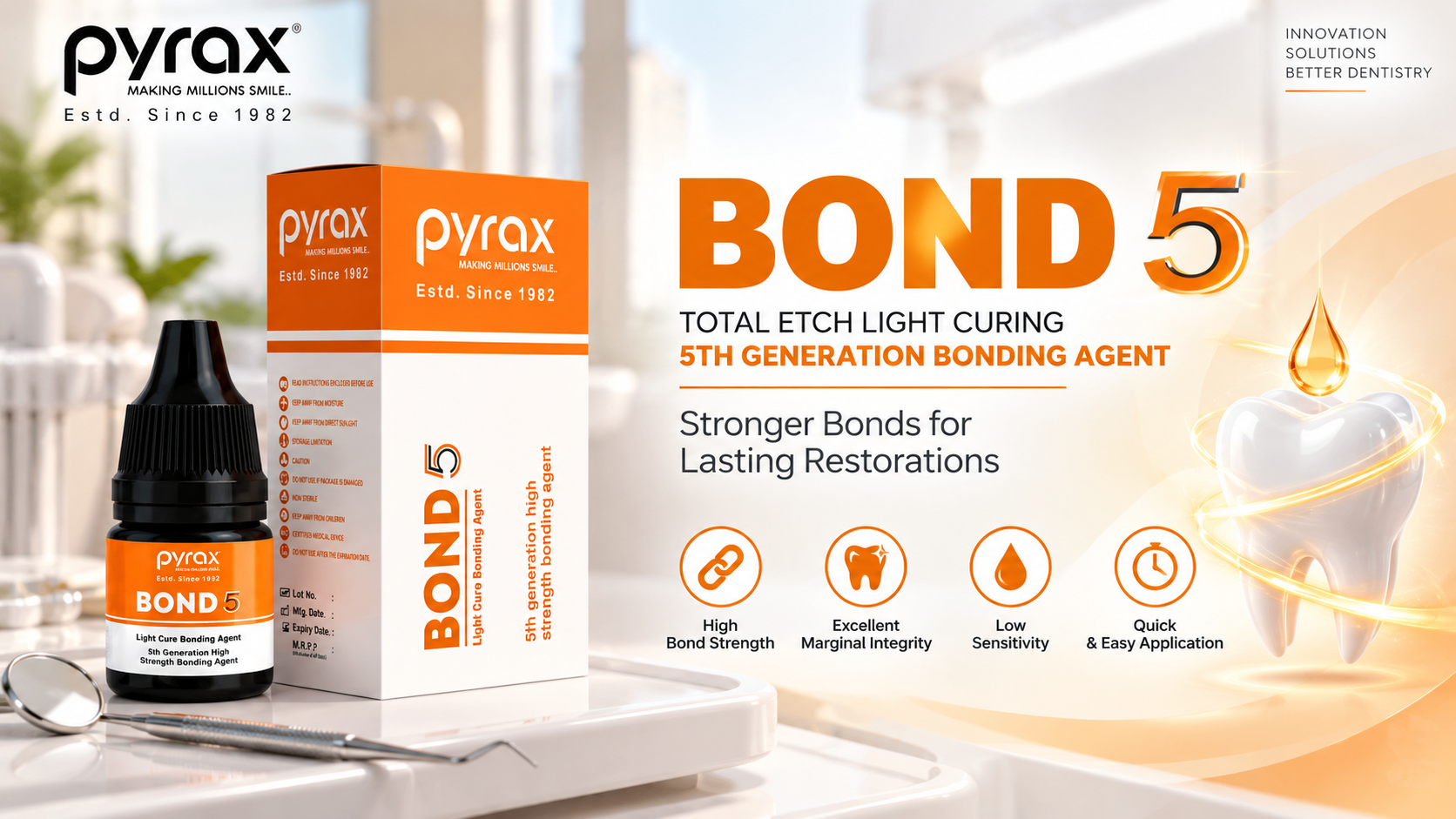
Bond 5: 5th Generation Light Cure Bonding Agent
Bond 5 is a 5th
generation light cure bonding agent developed for use with composites. The
dental material supplier describes it as a total-etch bonding adhesive designed
to promote adhesion to enamel and dentin.
The product is
designed to be used with Pyrax Caviact Dental
Etching Gel as part of the tooth-surface preparation and bonding protocol. It also
states that the adhesive is intended for applications involving composite
restorations, veneers, crowns, and other adhesion treatments.
Its product
information highlights wetting ability, penetration into dentinal tubules,
handling, and clinical bonding performance as key characteristics.
For dentists seeking
a 5th generation light cure bonding agent, Bond 5 can be considered as part of
an adhesive restorative workflow.
Frequently Asked Questions
What is a 5th generation bonding agent?
A 5th generation
bonding agent is generally an etch-and-rinse adhesive system in which the tooth
surface is etched separately before application of the bonding adhesive.
Is a 5th generation
bonding agent used with composite?
Yes.5th generation
adhesives are widely used as part of the bonding techniques in resin composite
restorations.
What is the difference between 5th and 7th generation bonding agents?
The main distinction
is the adhesive approach. 5th generation systems generally use a separate
etching step, while 7th generation systems are commonly self-etch adhesives
that combine conditioning and priming within the adhesive system.
Is bonding technique important?
Yes. Isolation,
surface conditioning, etching, applying an adhesive, solvent evaporation, and
light curing may all affect the quality of bonding. Dentists need to adhere to
the manufacturer’s instructions.
What is Pyrax Bond 5?
Pyrax Dental Bond 5 is a 5th generation light-cure bonding agent designed for
bonding to enamel and dentin and for use with nano hybrid composites.
Conclusion
5th generation
bonding agents are still a choice in adhesive restorative dentistry. Their
etch-and-rinse method offers an organized bonding process for procedures
involving enamel, dentin, and resin-based restorative materials.
To get reliable
outcomes, dentists must take into account clinical indications, compatibility
with restorative materials, proper isolation, correct application technique,
and the manufacturer’s instructions. These factors play a role in the success
of any bonding procedure.
Bond 5 is a
one-bottle cure bonding system that belongs to the 5th generation. It is made
for use with composites for restorations and other adhesive applications. Its
design simplifies the process while maintaining bonding performance.
Comments (0)