

Dental alginate impression material is a powder made from seaweed that, when mixed with water, turns into a gel which is used to record the anatomical details of the mouth. That's the alginate meaning worth remembering. Within the broader family of impression materials, this is classified as an irreversible hydrocolloid impression material, a term that separates it from reversible hydrocolloids like agar, which can be melted down and re-gelled. Once this impression sets, it stays set.
Why do dentists use alginate in dentistry so consistently, decade after decade? Mostly because it asks so little in return for what it delivers. No special equipment, no long setting delays, no real learning curve. Patients tend to tolerate it better than stiffer or more resin-heavy materials, too, which matters more than textbooks sometimes give it credit for. Its role in dental impressions spans a wide range of everyday clinical needs like orthodontic study models, preliminary impressions taken before a custom tray is fabricated, denture work, and mouthguards, which is exactly why this impression is usually the first thing a dentist reaches for when precision isn't the only thing on the line.
So, let’s clearly understand what the material is, its composition, the setting chemistry, how to mix the material properly, where it gets used clinically, and how it holds up against agar and silicone. There's a buying guide section near the end, too, covering pricing and what's worth checking before placing an order
What Is Alginate Impression Material?
Definition: A dental alginate impression material is an irreversible hydrocolloid impression material, a colloidal system in which powdered alginic acid salts (sodium or potassium), once mixed with water, react with a calcium-containing compound to form a set, elastic gel capable of reproducing the fine detail of oral hard and soft tissues.
History: The material came about in the early 1900s as a simpler alternative to agar, which at the time needed water-jacketed trays and conditioning units most practices didn't have lying around. It just needed a bowl, a spatula, and some water. This practicality has made the material the go-to material for every dentist.
Classification: Alginate in dentistry is classified into two types. They are
|
Type 1 – fast setting |
Gels in roughly 1–2 minutes |
|
Type 2 – Normal setting |
Gels in roughly 2–4.5 minutes |
Why is it called an irreversible hydrocolloid?
Dental alginate sets through a one-way calcium cross-linking reaction which can’t be reversed, and the dispersing medium for this material is water, making it a hydrocolloid. So, it is called an irreversible hydrocolloid impression material.
Composition of Alginate Impression Material
| Chemical components | Role |
| Sodium Alginate (15%) | The core sodium material ingredient, derived from seaweed extract, forms the actual gel |
| Calcium Sulfate (16%) | The reactor; it supplies calcium ions that trigger gelation. |
| Trisodium Phosphate (2%) | The retarder reacts with calcium first to delay gelling and control working time. |
| Diatomaceous earth (60%) | The filler bulks up the mix and gives the set gel body and a smoother texture. |
| Potassium Titanium Fluoride (3%) | The fixer neutralises it's tendency to inhibit gypsum, so stone casts pour clean. |
This table explains the role of each ingredient briefly.
As for the alginate dental impression materials: chemistry, structure and properties, picture sodium alginate as a long chain with mannuronic and guluronic acid units. The replacement of sodium ions by calcium along the chain triggers the formation of a gel network through the connection of neighbouring polymer chains, which creates the permanent structure that holds the details of the mouth really well.
Properties of Alginate Impression Material
There are six properties that really shape how it performs. They are:
Elasticity: Flexible enough to be withdrawn past bony and soft-tissue undercuts without tearing, as long as removal is quick.
Tear strength: The weak point; It is lower than elastomers, especially in thin interdental sections.
Dimensional stability: Reduces over time, since water loss and water uptake both distort the set gel.
Accuracy: Good enough for study models and diagnostic casts, not for fine, micron-level work.
Flexibility: Enough to navigate undercuts while still springing back close to its set shape.
Biocompatibility: Generally well tolerated, which is a big part of why it stays a default choice. Taken together, these properties explain both why the material is so widely trusted for routine dental work and exactly where its limits lie.
Setting Reaction of Alginate
The setting reaction:
Soluble Alginate + Calcium Sulfate ? Calcium Alginate gel
Here, the calcium takes the place of sodium along the polymer chain, and that change is what leads to the formation of the gel.
The setting time depends on the type of it. There are three types. Normal setting sets in roughly 2 to 4.5 minutes at room temperature, and it's the version most dentists use. Fast-setting cuts the setting time down to 1–2 minutes, useful for a patient with a strong gag reflex or a tight schedule. Slow-setting goes the other way, stretching working time out for more complex or multi-unit impressions where extra minutes can help.
Alginate Water Powder Ratio & Mixing Technique
Getting the water-to-powder ratio right does most of the work here. All types of it have roughly equal measures of powder and water. But to confirm the exact water-powder ratio, check the scoop and cylinder that came with it rather than guessing.
Here's how to mix alginate impression material, step by step:
Give the powder tin a good shake before scooping, since it settles during storage. Measure both powder and water carefully. Tip the powder into the water inside a flexible rubber bowl. Then mix with a stiff-bladed spatula, in a figure-of-eight motion against the bowl walls until it turns smooth and creamy, with no lumps and no air trapped in.
The common mistakes that dentists make while mixing alginate:
- Careless measuring.
- Stopping the spatulation too soon leaves the mix grainy.
- Overdoing it (eats into working time).
- Trapping air through sloppy technique.
Mixing time: Manual manipulation takes 45 to 60 seconds, and manipulation with a mechanical mixer will take less time and produce fewer air bubbles. The mixing time also depends on water temperature. As the temperature of water increases, the mixing time reduces, and if the temperature decreases, the reaction slows down and mixing time increases. So, the dentist can play around with it depending on the requirement.
Clinical Uses of Alginate Impression Material
The uses are:
- Orthodontic models: It is the best material for orthodontic work.
- Study casts: For documentation and patient conversations.
- Preliminary impressions: Taken before custom tray fabrication.
- Denture impressions: Primary impressions in complete and partial denture cases.
- Mouthguards: For sports guards and night guards.
- Diagnostic casts: Supporting occlusal analysis.
Across all of these, alginate used in dentistry comes down to one thing: wherever speed and cost matter more than micron-level precision, it's usually the material of choice.
Advantages and Disadvantages of Alginate
The advantages of are:
Low cost: Cheaper than elastomers by a wide margin.
Easy manipulation: Needs just a bowl and a spatula.
Patient comfort: Shorter set times and flavoured options make it easier to tolerate.
Hydrophilic nature: Captures reasonable detail even in a wet oral environment. This in dental science also has some disadvantages:
Poor dimensional stability: Syneresis and imbibition distort the gel if the pour is delayed.
Cannot be stored long: Pour within 10 to 15 minutes of removal.
Lower accuracy than elastomers: Not accurate enough for prosthodontic treatments.
Alginate Impression Procedure Step-by-Step The steps are:
Patient preparation: Explain what's coming, get the patient seated, manage any gag reflex concerns before starting.
Tray selection: Pick a dental impression tray sized to give even spacing around the arch.
Powder measurement: Measure the powder using the manufacturer's scoop.
Water measurement: Measure the water using the calibrated cylinder.
Mixing: Spatulate to a smooth, bubble-free consistency.
Loading tray: Now it is loaded into an impression tray from one end to take teeth impressions.
Taking impression: Seat the tray with firm, even pressure and hold until fully set.
Pouring cast: Pour the teeth mould into dental stone as soon as possible to prevent the teeth mould from turning into a dimensionally unstable model.
Types of Impression Materials Comparison
| Material | Accuracy | Usage |
| Alginate impression material | Medium | Diagnostic impressions |
| Silicone impression material | High | Fixed prosthodontics and preliminary bite registration |
| Dental impression compound | Low–medium | Preliminary impressions |
| Polyether | High | Implant dentistry |
| Putty impression material | High | Preliminary bite registration |
| Dental impression plaster | Low-medium | Primary impressions for edentulous ridges |
Syneresis and Imbibition in Alginate
| Heading | Syneresis in Dentistry | Imbibition in Dentistry |
| Water loss | Gel contracts, loses moisture | Not applicable |
| Water absorption | Not applicable | Gel swells, gains moisture |
| Storage methods | Pour promptly to limit shrinkage | Keep dry to limit swelling |
| Effect on accuracy | Impression shrinks, distorts | Impression swells, distorts |
Best Alginate Impression Materials
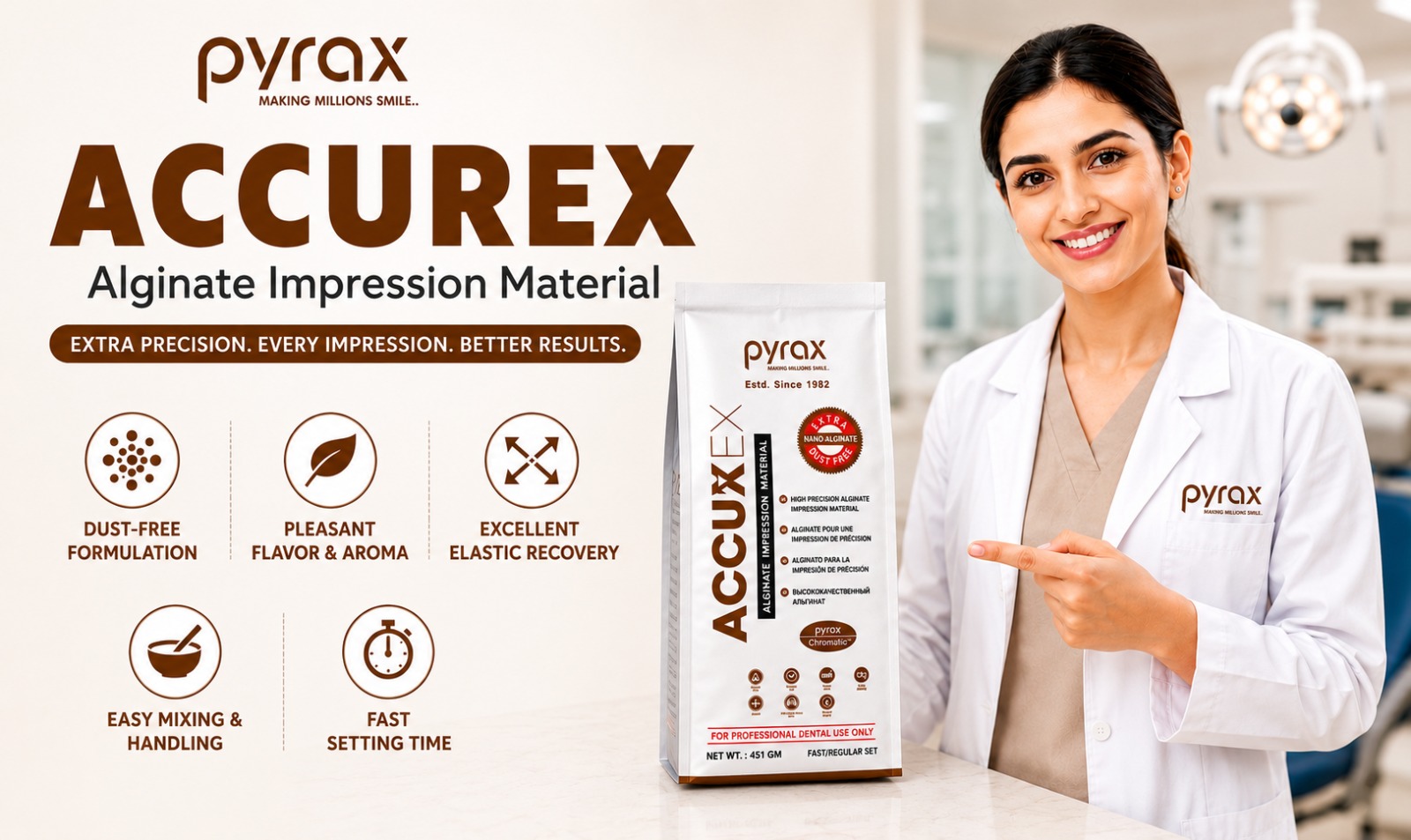
Among the established names in this category, Pyrax Dental is a strong candidate when evaluating the best ones. The best alginate impression material- Pyrax Dental offers both Chromatic and Non-Chromatic.
The dental product has a colour-changing indicator that shifts shade through the mixing, working, and setting stages. This provides a clear visual reference at each stage, supporting accurate timing and consistent handling during the impression procedure. The PYRAX Non-Chromatic offers the same level of accuracy and smooth consistency without a colour indicator, suiting clinicians who follow conventional manipulation methods.
| Review Criteria | What to Look For |
| Material brand | Established suppliers such as Pyrax Dental, offering consistent batch quality |
| Setting time | Normal, fast, or slow-set variants to match the clinical scenario |
| Accuracy | Sufficient detail reproduction for diagnostic and orthodontic casts |
| Mixing properties | Smooth, lump-free consistency with minimal air entrapment |
| Clinical suitability | Fit for study models, preliminary impressions, and denture work. |
Buying Guide
A few things worth checking before you buy alginate impression material for the dental practice.
Price comparison: The price varies by brand and pack size, and in India specifically can shift with import duties. Compare per-unit cost across the few suppliers for dental supplies
Bulk buying: Ordering in bulk lowers per-unit cost for practices and labs with steady, ongoing impression needs. To order
Dental supplier – Pyrax Dental: Established suppliers like Pyrax Dental carry ranges suited to study models, orthodontic, and prosthodontic work alike.
Product specifications: Check setting time, water-powder ratio, shelf life, and packaging format before you buy. You can check them by searching terms like “alginate impression material buy online India Pyrax Dental” on Google.
Conclusion
At the end of the day, it sticks around because it is affordable, quick, and good enough for the impressions that make up most of a day's dental work. Silicone and polyether will always win on raw accuracy when precision can't be compromised, but for study models, orthodontic records, and everyday casts, alginate is still the one most dentists reach for without a second thought.
Frequently Asked Questions
1. What is alginate impression material?
A. It's a powder that, when mixed with water, sets into a gel which is used to record dental impressions.
2. What is the water-to-powder ratio of alginate?
A. Most manufacturers recommend roughly equal measures of powder and water, per the product's own scoop and cylinder.
3. How long does alginate take to set?
A. It depends on the types; a fast-setting alginate takes 1–2 minutes to set, and normal setting sets in about 2–4.5 minutes, and a slow-setting one takes even more time.
4. What are the ingredients of alginate?
A. Sodium, calcium sulfate, trisodium phosphate, diatomaceous earth, and potassium titanium fluoride.
5. Why is alginate used in dentistry?
A. Affordable, easy to mix, and comfortable for patients, making it ideal for diagnostic and preliminary impressions.
6. How should alginate impressions be stored?
A. Pour the cast within 10–15 minutes, or wrap briefly in a damp paper towel inside a sealed container.
Author
Dr. Kadarla Virat Kumar (BDS)
Malla Reddy Institute of Dental Sciences, Hyderabad
References
Comments (0)