

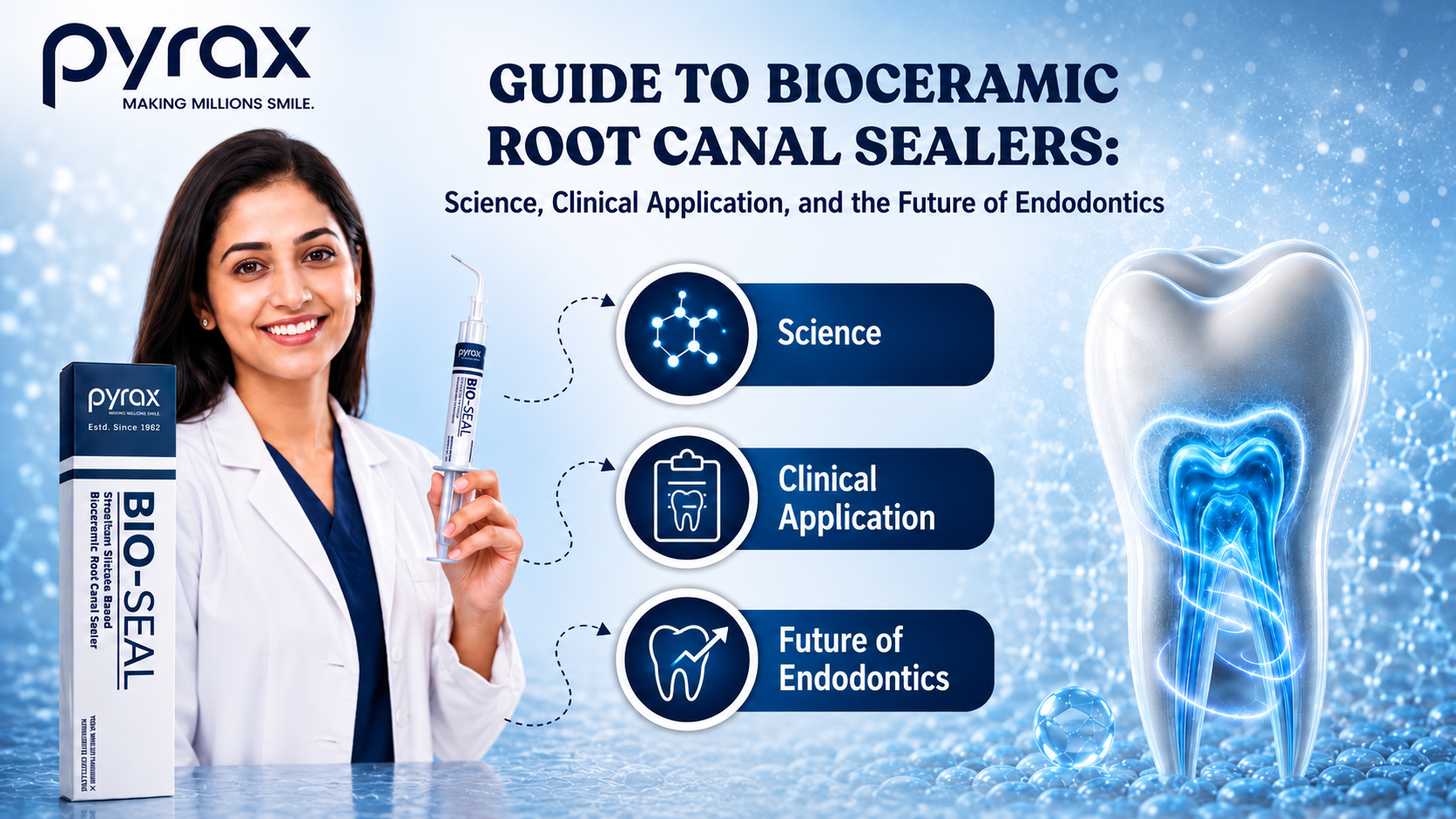
The Definitive Guide to Bioceramic Root Canal Sealers: Science, Clinical Application, and the Future of Endodontics
The way we fill root canals has changed a lot over time. For a time, the main goal of this treatment was to make sure the root canal was sealed really well using materials that do not react with the body. Now we want to use materials that are good for the body. This change has helped a lot of people get results from their treatment. Now people think that bioceramic root canal sealers are the choice.
They are better than the kind of sealers that were made from resin. In this guide, starting from 2026, we will discuss what bioceramic root canal sealers are made of. We will also look at how it helps in the clinic.
1. The Genesis of Bioceramics in Dentistry:
They are still a part of dentistry today. Why the Shift? Traditional sealers, particularly zinc oxide-eugenol and epoxy resin-based formulas, were often hydrophobic. They required a perfectly dry canal—a clinical impossibility given the microscopic moisture within dentinal tubules. They are, conversely, hydrophilic, meaning they don't just tolerate moisture; they require it to function. The Science of the Seal. To understand what is in a sealer is important for knowing how it will work in a human root canal. These are different from resin-based root canal sealers. Resin-based work involves a special chemical reaction that happens. This reaction is called polymerization. They work in a different way. They set when they get wet. This is called a hydration reaction. Bioceramic sealers and their hydration reaction are important to understand. They are used in root canals, and their composition is key to knowing how they will behave. Key Components: Strontium silicate and things like Tricalcium and Dicalcium Silicates are important. These are the parts that react to form a special kind of gel called strontium calcium silicate hydrate gel. This gel is also known as strontium calcium silicate hydrate, or CSH gel for short. I am going to call this stuff strontium calcium silicate hydrate gel because that is what it is. The strontium calcium silicate hydrate gel is made when you combine strontium silicate with types of silicates, such as Tricalcium and Dicalcium Silicates. The strontium calcium silicate hydrate gel is formed from these things. Calcium Phosphate Monobasic: This allows for the formation of hydroxyapatite, creating a chemical bond with the tooth structure. Zirconium Oxide/Tantalum Oxide: These are radiopacifiers. High radiopacity is a critical property of bioceramic sealers, allowing for clear post-operative validation on patient radiographs. Fumed Silica: Enhances the flowable consistency, ensuring the material can reach lateral canals and apical ramifications. 3. Physical and Chemical Properties. While evaluating the essential properties of it, clinicians focus on three very important properties: sealing ability, biocompatibility, and antimicrobial activity. Setting Time and Mechanism The final setting time of bioceramic sealer ranges from 2 to 4 hours. However, the "initial set" occurs relatively quickly. Because the material expands slightly (approx. 0.2%) upon setting, it creates a "hermetic" seal that resin sealers, which shrink upon polymerization, cannot match up with. High pH, high radiopacity, and Antibacterial Effect. Upon combining with available dentine moisture, bioceramics release calcium ions, increasing the pH level to 12 or higher. An alkaline environment is lethal to common endodontic pathogens. 4. A Comparative Analysis Choosing the best one depends on the case-to-case clinical needs (e.g., surgical vs. non-surgical). EndoSequence BC Sealer (Brasseler USA) The EndoSequence BC Sealer was the first premixed bioceramic to be accepted & used widely. Pros: Premixed syringe eliminates mixing possible errors; excellent flow; highly osteogenic. Cons: Higher bioceramic sealer price per application compared to powder-liquid systems. PYRAX ROOT CANAL SEALER (PYRAX) PYRAX RCS is a powder-liquid system designed for high purity. Clinical Advantage: It does not contain resin, making it arguably the most biocompatible option for patients with chemical sensitivities. Stability: It creates a high-quality mineralized plug, promoting rapid periapical healing. Comparison Table: Bioceramic vs. Resin Focusing on India. The demand for it in dental treatment has seen a high surge in the Asia-Pacific region. Bioceramic Sealer in India. The Indian dental market is price-sensitive. Bioceramic sealer price in India: Few Indian manufacturers are manufacturing quality sealers & the price typically ranges from ?1,000 to ?3,000 per syringe, depending on the volume and brand. The Retreatment Dilemma. A very common problem for dental clinicians is bioceramic sealer retreatment. Because these materials form a chemical bond with the dentin and are very hard when fully set, removal was once thought to be difficult. How to Perform Retreatment: Orifice Access: Use ultrasonic tips (Start-X or similar) to remove the hard material at the canal entrance.
Mechanical Removal: Use high-speed rotary files. Many manufacturers have released "re-treatment files" specifically designed for harder materials. Solvents: While traditional solvents like Chloroform have limited effects on bioceramics, mechanical agitation with EDTA can help soften the interface between the sealer and the canal wall. 7. Step-by-Step Clinical Protocol To maximize the advantages of it, follow this evidence-based protocol: Canal Preparation: Shape the canal to at least a 25/.04 taper using PYRAX PROFLEX GOLD FILES. Disinfection: Use PYRAX 5.25% sodium Hypo followed by PYRAX 17% EDTA solution. Moisture Control: This is the most critical step. Do not over-dry. Use one or two paper points to remove standing water, but leave the dentin "damp." Application: Inject the sealer into the apical third or coat the master gutta-percha cone. Obturation: Use a single-cone technique or cold hydraulic condensation. Avoid "warm vertical" techniques unless the specific bioceramic brand is labeled as "Heat Stable," as high heat can dehydrate the sealer prematurely. Hydrophilic Nature: Works in the presence of moisture. Zero Shrinkage: Ensures a superior seal over time. Bioactivity: Actually aids in bone and tissue repair. Radiopacity: Clear visualization for legal and clinical records. Is it Time to Switch? The evidence is clear: bioceramic materials offer biological and mechanical superiorities that resin-based root canal sealers simply cannot provide. While the bioceramic sealer price is higher, the reduction in post-operative pain and the increased long-term success rate make it an essential tool for any modern practice. Whether you are looking for the best ones for a complex case or a reliable endo sealer for routine work, the shift toward bioceramics in dentistry is a win for both the clinician and the patient. Frequently Asked Questions (FAQ) Q: Can I use warm gutta-percha with bioceramic sealers? A: Standard one may dry out and set too quickly with heat. Use "HiFlow" or "Heat Stable" versions specifically designed for warm vertical condensation. Q: Why is my bioceramic sealer not setting? A: It requires moisture. If the canal is excessively dried with alcohol or excessive paper points, the hydration reaction cannot occur. Q: Is BioRoot RCS better than EndoSequence? A: Both are excellent. BioRoot RCS is often preferred for its pure mineral composition, while EndoSequence is favored for its ease of delivery. To get the most out of sealers, you should do things in a certain way. 1. Canal Preparation: You need to make the canal a certain shape; it has to be at a 25/.04 taper. 2. Disinfection: First use 5.25% NaOCl. Then use 17% EDTA. 3. Moisture Control: This is the important part. You must not make the canal too dry. Use one or two paper points to get rid of the water that is just sitting there. Leave the dentin a little bit damp, as bioceramic sealers need. 4. Application: You need to put the sealer into the bottom part of the canal or put it on the master gutta-percha cone. 5. Obturation: You can use a single-cone technique or cold hydraulic condensation with sealers. You should not use " vertical" techniques with bioceramic sealers unless the ones you are using say it is "Heat Stable" because high heat can make these sealers dry out too fast. These materials are broadly categorized based on how the body’s tissues interact with them: 2. Molecular Composition:
5. Bioceramics in the Global Market:
6. Clinical Challenges:
8. Summary of Advantages:
9. Conclusion:
Step-by-Step Clinical Protocol
6. Summary of Advantages
1. Classification of Bioceramics
Category Characteristic Examples Bioinert It doesn't have any response towards tissues, showing less reaction. Alumina, Zirconia Bioactive It shows chemical bonding with dentin and shows healing. MTA, Bioceramic Sealers, Calcium Phosphates Bioresorbable It gets dissolved over time, and with that, the tissues that are natural it replaces them over time. Tricalcium Phosphate (TCP)
2. Core Composition & Setting Chemistry
Traditionally, endodontic bioceramics, like Biodentine or EndoSequence, are usually made of Hydraulic Calcium Silicates. While modern
- The main parts of these are Tricalcium silicate, Dicalcium silicate, and Calcium phosphates
- To make these endodontic bioceramics visible on X-rays, scientists add things, like Zirconium Oxide or Tantalum Oxide, to the bioceramics.
- When these materials get wet, even if there is a little bit of moisture in a tooth, they start to set. This is because they react with the water and form a kind of gel called Calcium Silicate Hydrate, and they also release Calcium Hydroxide. Modern endodontic ones, like Biodentine or EndoSequence, go through this process when they get wet.
3. Why Bioceramics are "Smart" Materials
They are smart because they help the body heal naturally.
Biomineralization: They give off calcium and phosphate, which mix with body fluids to make hydroxyapatite. This is the stuff that makes up real bone and teeth.
The Monoblock Effect: They bond with the dentin, which makes one piece. This piece is much better at keeping bacteria out than materials.
Osteoconductivity: They help the bone cells to grow. The bone cells, which are called osteoblasts, use them as a kind of bridge to grow across the bone. This is really helpful when we need to fix problems with the roots of teeth or heal lesions on the bone. They are very good at helping the osteoblasts do their job, which is to grow and fix the bone.
They help make the body fix itself by working with processes like biomineralization and osteoconductivity. They are good for fixing teeth and bones.
4. Top Clinical Applications
Bio-ceramic sealers have high alkaline pH and stability. These materials are used in critical dental applications :
Pulp Capping
Apexification
Perforation Repair
Regenerative Endodontics
_______________________________________
5. Popular Product Forms
Putty/Paste: High-viscosity putty versions used for surgery or repairing holes (e.g., iRoot BP Plus, Biodentine).
Injectable Sealers: Flowable materials used for standard root canals (e.g., Pyrax Bio-seal, TotalFill BC Sealer, CeraSeal).
Light-Cured Liners: Thinner layers used under fillings to protect the pulp (e.g., TheraCal LC).
Resin-Based Root Canal Sealers: The Time-Tested Standard in Endodontics
While the dental world is buzzing about the "bioceramic revolution," resin-based root canal sealers remain the most widely used and clinically documented materials in endodontics. For decades, epoxy resin formulas have served as the "gold standard" against which all new endodontic sealers are measured.
What are Resin-Based Sealers?
These sealers, such as the world-renowned AH Plus, are typically paste-paste systems consisting of an epoxy resin and an amine paste. Unlike bioceramic materials, which rely on a hydration reaction, resin sealers set through a chemical polymerization process.
Why Do They Remain Popular?
Resin-based root canal sealers have been used as an all-time favourite in clinical dentistry due to several key factors:
- Exceptional Dimensional Stability: Resin-based sealers have low solubility after setting, and resin sealers have very low solubility. Material does not wash out over time, ensuring the long-term integrity of the root canal fill.
- Superior Flow Characteristics: Resin sealers having "creep" property that allows them to flow deeply into the microscopic lateral canals.
- Ease of Retreatment: The greatest edge over bio-ceramic root canal sealers is the ease of removal. If a tooth requires a second treatment, resin sealers can be easily softened with heat or dissolved with standard solvents like chloroform & removed from the canal.
- High Radiopacity: They show up clearly on X-rays, allowing dentists to verify a dense, complete fill to the very tip of the root.
Major Disadvantages of resin-based sealers :
Despite their reliability, resin sealers have limitations compared to modern bio ceramics :
- Shrinkage: Bio ceramics after setting expand slightly in canals, while resins undergo slight shrinkage during polymerization, which can create tiny gaps for bacteria.
- Hydrophobic Nature: Resin sealers bond properly only when canals are fully dried. Any residual moisture can interfere with the seal.
- Initial Toxicity: Epoxy resins can be mildly irritating to the periapical tissues if extruded past the apex.
Resin vs. Bioceramic: The Verdict
Selecting between a resin-based root canal sealer and a bioceramic sealer often comes down to the clinician's choice, and as per the clinical situation. Resin remains the "safe bet" for cases where future retreatment might be a possibility or where a cost-effective, proven solution is required.
In markets like India, while these sealers' prices are coming down because of affordable products like Pyrax Bio-Seal, bioceramic sealers are now a high-performance staple in every dental operatory.
________________________________________
BUY PYRAX Bioceramic Root Canal Sealer: The Next-Generation Strontium Silicate-based
Check out our more Endodontic Materials
In the rapidly evolving world of endodontics, PYRAX BIOSEAL (by PYRAX Dental) has emerged as a formidable competitor to established brands like EndoSequence. As a "New-generation" Strontium silicate-based bioceramic, it is designed to ease the obturation process while providing a superior biological seal.
What Makes PYRAX BIOSEAL Different?
Unlike traditional resin-based root canal sealers that require manual mixing and a perfectly dry canal, it is a pre-mixed, syringe-driven system. It is specifically formulated to thrive in the moist environment of the root canal system.
Key features include:
- Unique Stability: It is physically stable due to its unique strontium silicate-based formulation; it neither shrinks nor expands significantly during the setting. This prevents "wash-out" and ensures the seal remains intact for years.
- Rapid Setting Time: Setting time is approx. 3.5 hours, it sets faster than many other bioceramics, reducing the risk of material displacement before the final restoration is placed.
- High pH: It maintains a pH of 12.73. High alkalinity provides a potent antimicrobial effect, neutralizing any bacteria remaining in the complex anatomy of the canal.
Clinical Benefits and Application
It is optimized for the Single-Cone Technique, which has become increasingly popular in digital marketing for modern dental clinics due to its efficiency. Its high flowability (23mm) allows it to reach accessory canals and apical ramifications that traditional pastes might miss.
Why Clinicians Prefer us:
- Biocompatibility: It accelerates the formation of hydroxyapatite, creating a "mineralized" bond with the dentin.
- Radiopacity: At 8mm Al, it provides excellent contrast on X-rays, making it easy to distinguish from tooth structure and bone.
- Non-Staining: Its high-purity mineral composition ensures that it won't cause the crown discoloration sometimes seen with older MTA-based sealers.
Price and Availability in India
PYRAX BIOSEAL offers a high ROI. The price for a 2g syringe is Approx. Rs 2000 in India. Given that one syringe can treat multiple cases without the waste associated with manual mixing, it is a cost-effective premium option.
Summary
If you are looking to upgrade from endo sealers that shrink or require complex mixing, our product represents the pinnacle of convenience and biological performance. It effectively bridges the gap between clinical efficiency and long-term apical healing.
Comments (0)