

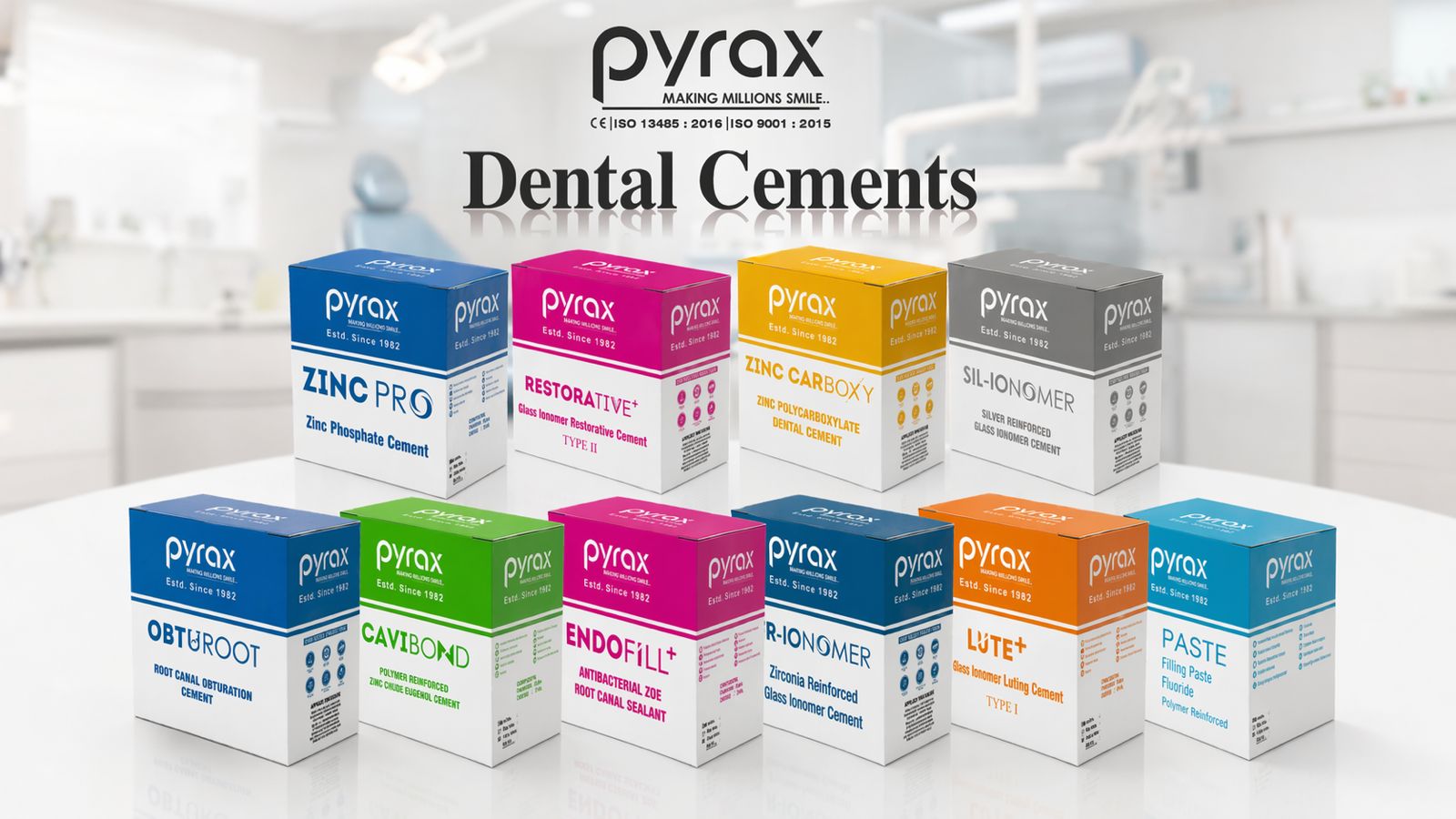
1. INTRODUCTION TO DENTAL CEMENTS
1.1 WHAT ARE DENTAL CEMENTS?
Dental cements are materials prepared by mixing components, usually powders and liquids, which then set, providing a method for retention of restorations, space filling, and use as liners and bases. They are acting as binding agents, providing adherence, sealing of margins, and support for restorations
1.2 WHAT ARE DENTAL CEMENTS USED FOR?
The principal purpose of dental cements is to retain restorations such as crowns, bridges, and orthodontic bands or brackets onto tooth structure. They are also employed as liners, bases, and temporary fillings, which provide insulation for pulp, seal marginal surface, improve retention, and provide lasting support in operative and preventive dentistry.
1.3 WHAT IS DENTAL CEMENT MADE OF?
The structure of cements includes a powder (in which the metallic oxide, the glass, or an organic resin is included) that can react with an acidic liquid or with a polymerizable monomer liquid. The adhesion to the tooth, seal of the dental restoration, or its support by use of dental cement depends on its formulation, dictating the adhesive property and strength, and biocompatibility of the dental cements.
1.4 WHAT DOES DENTAL CEMENT LOOK LIKE?
Dental cement is a double-setting product, made of a powder and liquid, which are mixed and produce a creamy paste that is ready to use. The mix is of a firm, yet stringy, nature and can be opalescent to semi-translucent with varieties of white, off-white, and tooth colour, so it is compatible with present tooth and restorations
1.5 WHAT DOES DENTAL CEMENT TASTE LIKE?
The taste of dental cement ranges from non to unpleasant and is either bitter, metallic, or acid based on its composition. New cements reduce the taste and irritation substantially and so are more acceptable to the patient; usually, there is just a mild, transient taste which is very transient until it cures in the mouth.
1.6 WHAT IS TEMPORARY DENTAL CEMENT?
It is used in dental applications to maintain the position of a temporary restoration. It retains a crown or bridge to the tooth temporarily. Its low bond retention properties will ensure it can be easily removed as needed, suitable for its temporary nature, protecting the underlying tooth, and allowing normal oral function with patient comfort.
1.7 WHAT DENTAL CEMENT IS PERMANENT?
Permanent dental cements are excellent for securing items firmly. Forms bonds that last many years. This makes permanent dental cements perfect for crowns. These things work well for bridges, inlays, and other dental devices like that.
1.8 WHAT DENTAL CEMENT DO DENTISTS USE?
Selecting appropriate dental cements by the dentist in response to clinical requirements. The adhesive properties of resin, glass ionomer, zinc phosphate, and resin-modified glass ionomer are really good. These things help with retention. They release fluoride in a manner that helps in getting effective & good results
1.9 WHAT IS THE DIFFERENCE BETWEEN DENTAL CEMENT AND FILLINGS?
Dental cements and fillings have jobs. Dental cement is used to hold crowns or bridges in place. Dental Fillings are used to fix damaged teeth so that they can make teeth work properly again. Fillings and dental cement are both important, but they do different things.
2. TYPES & CLASSIFICATION OF DENTAL CEMENTS
2.1 CLASSIFICATION OF DENTAL CEMENTS
The classification of dental cements is explained in different sources as a method of grouping materials based on composition, mechanism of setting, and function of use. It is also described as a classification based on chemical composition, such as acid-base or resin-based systems, and function of use, including luting, lining, or restorative use.
2.2 CLASSIFY DENTAL CEMENTS
Various sources describe classifying dental cements as a method of grouping materials by shared characteristics. Dental cements can be classified in various ways. Some people look at what dental cements are made of and how they react. Others think about how dental cements are used in the dental office. Overall, classifying cements helps us understand them better, compare dental cements, and pick the right dental cements for certain dental work.
2.3 TYPES OF DENTAL CEMENTS
Dental cements are utilized by dentists for repairing or restoring teeth, and the variation in dental cements is based on their mechanisms or functionalities. Traditional zinc phosphate remains fixed primarily by adhering to the tooth. Glass ionomer adheres to the tooth by creating a chemical bond and simultaneously releases fluoride, which aids in its protection. Polycarboxylate additionally forms a chemical bond with the tooth. Resin cements run because of their robustness, visual attractiveness, and excellent bonding to the tooth.
2.4 CLASSIFICATION OF DENTAL CEMENTS ACCORDING TO PHILLIPS
Phillips groups cements based on what they do in a dental clinic. This helps make them easier to use. Luting cements are meant for fixation, restorative cements for rebuilding tooth structure, and liners or bases for pulp protection. This approach emphasizes function, unlike other classifications that focus mainly on composition or setting reaction.
2.5 WHAT ARE THE THREE TYPES OF DENTAL CEMENTS?
There are three kinds of cement. They have differences in their descriptions.. They all mean the same thing. The luting cements are for retaining restorations, the restorative cements are for the restoration of the tooth, and the liners/bases are for the protection of the pulp. The main aim of the dental cement explanations is to assist, fix, and protect the teeth
2.6 WHAT IS TYPE 1,2,3 & 4 CEMENTS?
These cements are divided into four types based on their functions: Type I cements are used as luting agents for cementation procedures. Type II cements are designed for restorative purposes. Type III cements act as liners or bases to protect the pulp. Type IV cements are used for jobs in some dental work, showing that dental cements can be used in many different ways, for Type IV cements. This means Type IV cements have uses than people think.
3. PROPERTIES & STRENGTH OF DENTAL CEMENTS
3.1 WHICH IS THE BEST DENTAL CEMENT?
There are several categories of dental cements, and each of them are chosen purposely. The first category is resin cements, which have a strong structure and look like natural teeth. The second category is glass ionomer cements; these cements give off fluoride ions into the mouth and bond chemically to the tooth. The third category consists of zinc-based cements, which give results over time. Choosing a cement requires thinking about the exact procedure and also about how long the restoration has to last. Often, the dentist makes the decision by looking at the patient’s needs and the physical demands of the work. The dentist looks for reliable options and can explore the best dental cements and adhesives designed for a range of restorative and cosmetic dental procedures.
3.2 WHICH IS THE STRONGEST DENTAL CEMENT?
Resin-based dental cements provide the highest levels of connection to tooth structures - those materials remain stable over long periods of time - but glass ionomer cements offer a connection of moderate force. In this case, the material releases fluoride ions into the surrounding area. There are also zinc-based cements with low attachment power. Due to their consistent performance, clinicians find those materials dependable.
3.3 WHICH IS THE MOST SOLUBLE DENTAL CEMENT?
Zinc phosphate cement dissolves easily in the mouth, and zinc oxide eugenol cement breaks down at a similar rate. Both materials disappear faster than modern alternatives. It is common for glass ionomer cement to show a medium rate of loss, but resin cement stays intact the longest. In most studies, researchers define a high rate of dissolution as a lack of stability. A material's duration is directly related to its rate of disappearance. For the results, material that dissolves fast lacks the ability to remain solid.
3.4 WHICH DENTAL CEMENT IS RADIOLUCENT?
X-rays don't make radiolucent cements appear. This is because radiolucent cements do not show up well on these pictures, called radiographs. It is hard to tell what is what when radiolucent cements are used so identification of cements is difficult. Resin-based cements and temporary cements may exhibit radiolucency; however, this is not characteristic of radiopaque glass ionomer and zinc-based cements. Definitions suggest that radiolucency is connected to composition and may influence the interpretation of diagnosis during subsequent evaluations
3.5 WHICH DENTAL CEMENT IS MOST IRRITATING TO THE PULP?
In the setting reaction in zinc phosphate cement, the material starts showing a low pH. Because this acidic state exists during the early stages, the substance causes inflammation in the pulp tissue. There is a chemical process that affects the internal parts of the tooth. Due to the high acidity, the cement functions as an irritant. By comparison, polycarboxylate and glass ionomer materials cause a smaller amount of damage to the inner soft parts of the tooth, and pulp inflammation reduces with the use of zinc oxide eugenol.
3.6 WHICH DENTAL CEMENT HAS THE HIGHEST COMPRESSIVE STRENGTH?
In some cases, resin-based cements are very strong when squished. They show levels of resistance to compression. Resin-based cements hold up under pressure. As a result, they remain intact when a person bites with great force. Although the zinc phosphate cement is strong, it is weaker than the other materials; the strength of the glass ionomer cement is at a medium level.
3.7 IS DENTAL CEMENT STRONG?
The strength of dental cement is also regarded, but it varies depending on the type and use. Resin cements are known for their durability and bond strength, but traditional cements like zinc phosphate have average strength. However, all definitions of dental cement are in agreement that it is strong enough for use but not as strong as tooth structure.
4. USES & APPLICATIONS OF DENTAL CEMENTS
4.1 DENTAL LUTING CEMENT
According to scientific literature, the common definition of luting cement is a dental material used to cement or fix an indirect restoration, such as a crown or a bridge, to a prepared tooth. It is a thin layer of material that fills the space and may provide mechanical or chemical retention to ensure the stability and prevent displacement.
4.2 WHAT CEMENT IS USED IN DENTAL FILLINGS?
In clinical settings, dental cement functions as a material for repairing tooth structures. Some varieties are hard enough to resist wear over long periods, but different types are formulated to bond to the surface and emit fluoride. As an example, glass ionomer is a common material for those procedures. There are also resin-based options for practitioners - those materials are there to create a seal over the tooth. With the substances, the internal parts of the tooth stay protected. It is needed for the restoration to be effective. The material helps the restoration work the way it should. Restoration runs better when the material is right; it makes it effective.
4.3 WHAT KIND OF CEMENT DO DENTISTS USE?
Some specialized and advanced cements are used for the luting, restoring teeth, and lining. While some sources stress the strength and retention properties of the cements, other sources focus on the adhesive properties, sealing capabilities, and biocompatibility. The cements may be glass ionomer cements, zinc phosphate cements, and resin-based cements.
In dental practice, those materials are common for joining surfaces together. To fix a tooth, some people use them to replace missing structure. With other applications, the materials act as a barrier for the pulp. There is a focus on how long the cement lasts without breaking, but other users prioritize how well the material sticks to the surface. It is also important that the substance creates a tight seal. For safety, the material is compatible with living tissue. One example is glass ionomer cement. Another type is zinc phosphate cement. There is also polycarboxylate cement. And some options are resin-based cements.
4.4 DENTAL CEMENT FILLING
Dental cement filling is a restoration material for repairing tooth decay and damaged teeth. Some describe it as a protective and sealing agent, while others describe it as having strength and adhesive properties. Glass ionomer cements and resin-based cements are examples of restoration materials for tooth form restoration, leakage prevention, and long-term tooth durability.
4.5 PERMANENT TOOTH FILLING CEMENT
The permanent tooth filling cement, a material with good strength for tooth damage restoration, is discussed. Some texts discuss the strength and durability; some discuss the adhesive, sealing, and biocompatibility aspects. Glass ionomer and resin-based cements have good stability, leakage resistance, and functional maintenance under continuous oral stresses.
4.6 PERMANENT TOOTH CEMENT
Permanent tooth cements are materials that stay in the mouth for a long time - those substances are there to hold or replace parts of a tooth. Some versions are strong. Other types are made so that they stick to surfaces. For different products, the focus is on how well they close gaps. In some cases, the material is safe for living tissue - those cements are used to keep a tooth structure in place. By using them, the dentist makes sure the work is stable. With those materials, it is possible to stop fluids from seeping into the tooth.
4.7 TEMPORARY CROWN CEMENT
Temporary crown cement, also known as provisional dental material, is a cement used to hold crowns in place over a short period of time. Some of its benefits include ease of removal and low strength, while others include its ability to seal and protect the pulp. It is used as a temporary retention device, prevents contamination, and serves as a substitute until a permanent restoration or cement is placed.
4.8 WHITE CEMENT FOR TEETH
In dentistry, practitioners use white cements and tooth colored substances for aesthetic repairs. It is common to use glass ionomer to create a bond with the tooth. There are resin-based materials that resist pressure during use. By using those substances, professionals ensure the body accepts the repair. For this process, clinicians apply materials that seal the area. With the tools, it is possible to achieve a look that matches natural enamel. As a result, the restored tooth is durable.
5. SPECIFIC TYPES OF DENTAL CEMENTS
5.1 RESIN CEMENT
The resin cement is generally described in the scientific literature as a tooth-colored, polymer-based luting material consisting of dimethacrylate resins and inorganic filler particles, intended for luting restoratives. It is generally defined as a low-viscosity composite that polymerizes to a strong adhesion, conferring durability, low solubility, and a strong bond to enamel, dentin, and restorative materials.
5.2 ZINC POLYCARBOXYLATE CEMENT
Zinc polycarboxylate cement is a dental luting cement for restoratives that results from the chemical reaction between zinc oxide powder and polyacrylic acid, which is a biocompatible substance that chemically bonds to tooth structures and has moderate strength, low pulp irritation, and high adhesion for crowns, bridges, and orthodontic appliances.
5.3 ZINC POLYCARBOXYLATE CEMENT COMPOSITION
Zinc polycarboxylate cement composition is consistently described as a combination of zinc oxide powder with magnesium or stannous additives, mixed with an aqueous solution of polyacrylic acid. Scientific sources define it as a chemically reactive system where acid–base interaction forms a cross-linked matrix, enabling adhesion to tooth structure and providing biocompatible performance.
5.4 ZINC PHOSPHATE CEMENT
"A well-proven dental material that is produced by mixing zinc oxide powder with phosphoric acid" is how many people define zinc phosphate cement - it is strong enough to last for a long time. On that account, practitioners frequently use it to secure crowns. It is also suitable for attaching bridges. There is no chemical bond between the materials. The cement works - locking into the physical shapes of the surfaces. Because of this mechanical retention, the material is reliable - but the process is difficult to perform correctly.
5.5 ZINC PHOSPHATE CEMENT USES
Zinc phosphate cement is generally defined as a very versatile dental cement, which is primarily used for luting crowns, bridges, inlays, and orthodontic bands. Apart from that, a number of publications have stressed its significance as a foundation for dental restoratives, which is strong and stable as well.
5.6 POLYCARBOXYLATE CEMENT
In most cases, "a dental cement that is formed by mixing zinc oxide powder with polyacrylic acid" is the definition for polycarboxylate cement. As some sources note, this material is gentle when it touches tooth structures. It is also able to bond to enamel and dentin through a chemical process. For those reasons, many use this cement to attach restorations. Due to the way it adheres, it is reliable. There is also a level of strength in the material that is sufficient for its purpose. With its makeup, it does not harm living tissue.
5.7 3M LUTING CEMENT
The luting cement by 3M is widely referred to in literature and by the manufacturer as a resin-modified or glass ionomer-based cement intended for permanent retention of dental restorations. It has been defined as a cement that is easy to use and provides bonding, fluoride release, and sealing in a permanent manner.
Buy Pyrax Dental Luting Cement
6. HANDLING AND APPLICATION OF DENTAL CEMENTS
6.1 HOW TO APPLY DENTAL CEMENT?
Dental cements involve the application of the cement after the tooth is cleaned and dried. It is then prepared to the right consistency. All sources agree on the application to the restoration with careful pressure. They also differ on the time taken and the curing process. They all involve adhesions, sealing, and long-lasting protection.
6.2 HOW TO MIX DENTAL CEMENT?
Mixing of dental cements is done by taking an appropriate amount of both the liquid and the powder form, mixing them with each other for a certain period of time to make a smooth, textured, and bubble-free paste. This procedure ensures the strength of the cement.
6.3 HOW LONG FOR DENTAL CEMENT TO SET?
The time required for setting varies according to different kinds of cement. It is agreed that 3 to 10 minutes are required for initial setting, whereas full strength is attained after 24 hours. There are quick-setting varieties, while some take a little longer to set. Setting helps in strong bonding, sealing of the tooth, and protection of fillings or crowns.
6.4 HOW DOES DENTAL CEMENT WORK?
Dental cement works by being a strong bond between the teeth and the restoration material, which is usually the crown or the bridge. It fills the small gaps, hardens for stability, and prevents bacterial growth. Various sources have described the function of dental cement as follows: it holds the restoration in place and prevents the teeth from decaying or becoming sensitive.
6.5 HOW TO APPLY DENTAL CEMENT AT HOME?
The use of dental cement at home involves cleaning, applying some cement on the crown or the filling, and then pressing. Various sources have shown that one is required to strictly follow the instructions, avoid swallowing, and then remove the cement. A professional consultation is always recommended before the use of dental cement at home temporarily.
6.6 HOW TO MAKE DENTAL CEMENT AT HOME?
Manufacturing of dental cements at home is not completely safe. It needs special materials and mixing. It can damage your teeth if you try making it at home. Only a dentist can use dental cement. It is not safe to try making it by yourself.
7. REMOVAL AND MAINTENANCE OF DENTAL CEMENT
7.1 HOW IS DENTAL CEMENT REMOVED?
The cement is removed by a dentist using safe equipment. It's not recommended to try removing cement at home, as a dentist is a professional who is skilled in removing cement without causing any damage. It is not safe to try to remove cement on your own at home. Getting a professional to remove cement will keep your tooth healthy and ready for new work.
7.2 HOW TO REMOVE DENTAL CEMENT FROM A CROWN AT HOME?
Attempting to remove dental cement from a crown at home is unsafe. Once hardened, dental cement binds very well and can only be removed safely by a dentist using proper equipment. It is therefore best to have a dentist remove a crown to avoid damaging the tooth or crown itself.
7.3 HOW TO DISSOLVE DENTAL CEMENT?
Dental cement is not easily dissolved once set, as it is designed to be durable and resistant to saliva. It may soften when exposed to certain solutions; however, removal is achieved by mechanical means. This ensures a strong bond, stability, and protection of the tooth-restore interface.
7.4 WHAT DISSOLVES DENTAL CEMENT?
Most dental cements resist dissolving due to their strong composition. Although some can be softened by acids or specific dental solutions, no household products can safely dissolve these materials. Special techniques are generally needed to remove these cements from the tooth.
7.5 WHAT REMOVES DENTAL CEMENT?
Removing dental cement requires the right process for safe and effective results. Ultrasonic scalers and other hand instruments are used to gently clean excess cement. Sometimes, various chemical solvents are also used to soften the cement for easy removal, which prevents irritation in patients.
7.6 CAN DENTAL CEMENT BE REMOVED?
The dental cement is removable but is intended for strong adhesion. They also explain that dental cement removal is usually done by professional mechanical methods to prevent damage to the tooth or restoration. Though temporary dental cement is easier to remove than permanent ones, the latter should be handled carefully for safety and effectiveness.
7.7 CAN A DENTIST REMOVE DENTAL CEMENT?
Dentists are able to remove this cement with special equipment and techniques. Professionals, they explain, break and clean this bonded material without damaging the tooth or restoration, which is critical in ensuring a proper fit, avoiding damage, and promoting a healthy mouth, especially when dealing with strong, permanent cement.
8. ISSUES AND FAILURES OF DENTAL CEMENTS
8.1 WHAT CAUSES DENTAL CEMENT TO FALL?
The cement may fall off due to wear, lack of adhesion, moisture contamination during cementation, and strong chewing forces. Further, they state that tooth decay, a poor material fit, and old age may cause adhesion failure.
8.2 WHY DOES DENTAL CEMENT COME OFF?
The dental cement can detach due to weakened adhesion, saliva exposure, or heightened pressure from chewing actions, or other factors such as improper placement, poor-fitting restorations, or underlying tooth decay, which contribute to weakened bonding, leading to loosening, separation, and compromising restorations.
8.3 CAN DENTAL CEMENT COME OFF?
The dental cement may come off over a period of time due to the constant chewing action or due to exposure to moisture. Different reasons may lead to the flaking off of the dental cement, among them are poor bonding and poor fitting.
8.4 CAN DENTAL CEMENT CAUSE INFECTION?
Dental cement itself is not a germ that can cause infection. If it is used the wrong way, germs can get trapped under a tooth filling. This can happen if the edges of the filling do not fit properly or if people do not take care of their teeth. So infection is more about how dental cement's used, not the cement itself.
8.5 CAN DENTAL CEMENTS IRRITATE GUMS?
In some cases, dental cement could cause gum irritation rather than being harmful. Gum irritation is due to an excess of cement, chemicals, and a lack of fit, leading to excessive plaque formation. Hence, gum irritation is more dependent on the application of dental cement.
8.6 CAN DENTAL CEMENT CAUSE PAIN?
The cement does not directly cause pain, but it may be caused by irritation of the dentin, acidic properties, or microleakage. It seems studies have found that pain is usually linked to pulp sensitivity, bacteria or a fitting tooth. The state of the tooth is more important than the adhesive applied.
8.7 CAN DENTAL CEMENT MAKE YOU SICK?
Dental cements are bio-friendly and safe for use, but still, there remain some toxins. Although there are some side effects, such as sensitivity and reactions to the cement, feeling unwell is generally attributed to improper use, allergies, or buildup.
9. COST AND AVAILABILITY OF DENTAL CEMENT
9.1 TEETH CEMENT COST
The cost of dental cement varies depending on the type, procedure, and location. Dental cement material can cost between ?200 and ?800. The procedure cost, like cementing a crown, can range from ?4,000 to ?30,000. The total cost of cement and the procedure will depend on these factors. The type of cement and procedure affect the overall cost. Location also plays a role in determining the cost of cement and procedures.
9.2 WHERE TO BUY OR GET DENTAL CEMENT?
Dental cement is distributed or sold through professional dental channels, and it is mainly available at dental material suppliers' outlets, online stores, and at manufacturers, for professional use. The availability of the product also depends on professional need and material type, rather than the general public’s access to the product.
9.3 WHERE TO BUY TEMPORARY DENTAL CEMENT?
To find temporary dental cement, you can visit temporary dental cement suppliers. There are options in some pharmacies. By searching online stores, you can also locate those products. Simple kits are for use at home, but dentists use professional types that are formulated for strength. As your needs vary, the location for purchase changes. For clinical procedures, dentists use materials that are reliable and refined. Results remain consistent with professional oversight. You can also buy a temporary dental filling: Product 1 & Product 2? from authorized dealers in India
9.4 WHERE TO BUY PERMANENT DENTAL CEMENT?
In most cases, regular shops do not sell permanent dental cement. It is usually available from manufacturers who supply dental clinics and are termed as permanent dental cement suppliers. Because those materials are for professional use, companies control who can buy them. For dental treatments, the substances are reliable because they stay in place for a long time. With those materials, the bond is strong enough to resist breaking. As a result, dentists choose them to ensure the patient remains safe.
10. FAQs AND COMMON QUESTIONS ABOUT DENTAL CEMENTS
10.1 HOW LONG TO EAT AFTER DENTAL CEMENT?
When a dentist applies cement, the material needs time to harden before a patient eats. If the cement is temporary, it is best to wait for 30 - 60 minutes, but with permanent cement, the process is complete after multiple hours have passed. In this way, the material sets as it should. The chances of the result increasing for a long time if the bond is kept undisturbed.
10.2 HOW LONG WILL DENTAL CEMENT LAST?
As various factors exist, the time that dental cement remains in place changes based on its specific category and application. From what researchers observe when they compare materials, it is common for a temporary cement to remain stable for a period between a few days and multiple weeks, but a permanent cement is able to stay effective for many years if the conditions inside the mouth are stable plus if the professional applies the material correctly.
10.3 HOW STRONG IS DENTAL CEMENT?
As the durability of dental cement varies, it varies according to the specific category of the substance. If the cement is a temporary type, it possesses a low level of resistance to force so that a dentist can take it out with little effort, but when the cement is permanent, it is highly resistant to force so that it can secure crowns or bridges for many years. On this basis, the level of strength is not uniform. It is different because of the ingredients in the material and the way that a practitioner applies it.
10.4 CAN DENTAL CEMENT BE USED AS A FILLING?
Dental cement, while suitable as a temporary filling, is not appropriate as a permanent one. Research has compared dental cement is effective in the short term, but composite or amalgam is better in the long term. For the permanent filling, the dental cement chosen depends on the durability & sturdyness.
10.5 WHAT ARE THE SIDE EFFECTS OF DENTAL CEMENT?
Side effects of Dental cements show mildness but depend on the type of material and its use. Research comparisons report possible gum irritation, sensitivity, allergic reactions, and minor inflammation. In some cases, excess cement may trap bacteria. Thus, effects vary based on composition, placement technique, and individual response rather than the material alone.
11. TOOLS AND EQUIPMENT RELATED TO DENTAL CEMENTS
11.1 CEMENT SPATULA DENTAL
A cement dental spatula is a dental device intended for mixing and spreading dental cement materials during dental treatment procedures. Also known as a cement dental spatula, the device is flat and double-ended and is intended for mixing and transferring dental materials during dental treatment procedures.
11.2 OBTUNDENT DENTAL & EFFECT
An obtundent (obtundent) in the field of dentistry refers to a material that is used to reduce tooth sensitivity and ease pain. The material is a desensitizing material that obtunds the nerves during the process. The main purpose of the product is to ease the pain.
12. FAQ’s
12.1 WHAT IS THE 2 2 2 RULE IN DENTISTRY?
In dental medicine prescription, the term "2-2-2" rule refers to a plan for the prevention of tooth disease. It is a way for practitioners to compare different clinical studies. To follow this guideline, a person brushes their teeth two times each day for a duration of two minutes. And the individual goes to a dental clinic for an examination either one time every two years or two times every year.
12.2 WHAT IS THE GOLDEN RULE OF DENTISTRY?
The “golden rule” in dentistry refers to dentists aiming to avert issues before they arise, preserve as much of your natural tooth as they can, and ensure your comfort throughout the treatment process. It, in addition, emphasizes the "minimal" approach compared to aggressive treatment in modern dentistry.
12.3 CAN A DENTIST PULL TWO TEETH AT ONCE?
To perform two extractions at one time is permissible for the dentist, but this action depends on multiple conditions, such as how the patient feels physically, where the teeth are located, and how easily the dentist can remove them. Multiple extractions in one visit are possible, but it depends on the health of the patient.
12.4 WHICH CROWN IS BETTER, Emax OR ZIRCONIA?
As professionals test dental materials, the gathered information indicates that both options perform effectively even though they possess different qualities. In multiple studies comparing those materials, results show that Emax allows more light to pass through the material and has a visual appearance similar to human teeth. Because zirconia is more resistant to mechanical stress and can support greater physical loads, it typically remains intact for a longer period, but its durability does not mean it is the superior choice in every case. There are specific benefits for both substances - the appropriate choice relies on the individual circumstances.
Prashant Tyagi (4/25/2026)
Cost Effective and Reliable Products at Pyrax Dental
Reply - Payrax Dental (4/25/2026)
Thanks for your valuable feedback